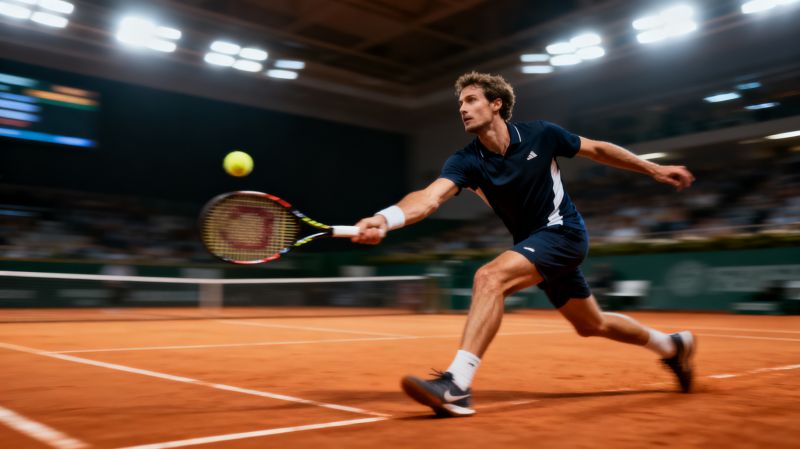
he Rolex Paris Masters doesn't get the hype of a Grand Slam, and that's precisely why it's so compelling. Held at the Accor Arena in Bercy, this ATP Masters 1000 event squeezes seven rounds into seven days on a surface that punishes hesitation. I've watched matches there where the ball skids so low off the back wall that returners are essentially guessing. It's a different sport from clay-court tennis, and the players know it. The 2023 final, with Novak Djokovic dismantling Grigor Dimitrov 6-4, 6-3。was a masterclass in first-strike tennis—Djokovic won 82% of his first-serve points and never faced a break point. That's Paris Masters in a nutshell: brutal efficiency rewarded, creativity punished.Why does Bercy produce such lopsided finals?The court speed, for one. Officially classified as indoor hard。the surface plays faster than most of the tour's hard courts, and the low bounce compresses reaction time. I remember a 2022 quarterfinal between Holger Rune and Carlos Alcaraz where Rune won 6-3, 6-7(5), 7-5—the match lasted nearly three hours, yet the average rally length was under five shots. Players who rely on heavy topspin, like Alcaraz, often struggle to control the ball's flight through the court. Serve-and-volley isn't dead here;it's just been renamed 'aggressive first-strike tennis.' The Paris Masters rewards a specific archetype: tall, flat-hitting baseliners with elite first serves. Daniil Medvedev, Alexander Zverev, and Djokovic have dominated the event for a reason.But the tournament's real charm lies in its chaos. The Paris Masters is the final Masters 1000 of the season, slotted right before the ATP Finals。and that timing creates a weird dynamic. Some players are fighting for Turin qualification;
others are already mentally on vacation. In 2019, unseeded Jo-Wilfried Tsonga—playing on home soil—made a surprise run to the quarterfinals before falling to Rafael Nadal. The crowd, notoriously rowdy for French players, can swing a match. I've seen Bercy turn on a player after a single double fault. It's not Wimbledon's polite applause;it's a football stadium's roar. That energy cuts both ways. French players have historically underperformed here relative to their rankings, and I'd argue the pressure of playing in front of that crowd is part of the reason. The last French champion?Jo-Wilfried Tsonga in 2008. That's a drought that gnaws at the tournament's identity.Logistics matter too. The Accor Arena is a multi-purpose venue—concerts, basketball games, the occasional tractor pull. The conversion to a tennis court takes days, and the practice facilities are cramped. Players have complained about the limited hitting courts and the cramped locker room. It's not a complaint you hear at Indian Wells, where the tennis garden feels like a small city. But the Paris Masters embraces its scrappy nature. The tournament director, Cédric Pioline, has pushed for upgrades。
and the 2024 edition introduced a new lighting system that supposedly improves visibility. Whether that translates to better tennis is debatable. I saw more than one player squint at the ceiling during night sessions last year.The Paris Masters remains a proving ground for a specific skill set: serving, returning。and closing points fast. It's not a place for grinders. If you want to understand why the indoor hard-court season matters, watch Bercy. The margins are razor-thin, the crowd is relentless, and the difference between a champion and a quarterfinalist often comes down to one service game. That's not a flaw—it's the point.